
Who Should Win the 2026 Ballon d’Or?
Harry Kane will win it, and he’ll deserve it. I’d still vote for Kylian Mbappé — and by the end of this you’ll know exactly why I’m probably in the minority.
Who I think wins
Harry Kane
73 goals in 65 games. The second-best scoring season by anyone since 2000.Who I’d vote for
Kylian Mbappé
Top scorer in La Liga, the Champions League and the World Cup. In one season.The record
22 in 22
Twenty-two World Cup goals in twenty-two World Cup matches, across three tournaments, at 27.The ceremony
26 October
London Palladium. Moved from Paris for the award’s 70th anniversary, honouring Stanley Matthews.On this page
Cold open
On the eighteenth of July, 2026, in Miami, in a match that officially did not matter — the third-place playoff, the game nobody grows up dreaming about — Kylian Mbappé did something that will still be argued about when the children watching that night are grown adults with children of their own.
Forty-eighth minute: he scores. That’s twenty-one World Cup goals. He has just pulled level with Lionel Messi at the top of the all-time list.
Sixty-sixth minute: he scores again.
Twenty-two.
Not twenty-two in a career of five World Cups and thirty-one matches, the way Messi got to twenty-one. Twenty-two goals in twenty-two World Cup matches. Three tournaments. He was twenty-seven years old.
And France lost that game six-four to England. So the man who now sits alone at the summit of the most exclusive scoring list in the sport walked off the pitch having finished fourth at a World Cup, in a season where he won absolutely nothing.
Which brings us to the London Palladium, on the twenty-sixth of October, and the strangest Ballon d’Or argument in years.
I’m Etienne Noumen, this is The Black Mambas of Football and Soccer Podcast, and by the end of this episode I am going to give you my top three — and then I’m going to tell you who I think should actually lift it, and I’m going to tell you why I’m probably in the minority.
Stay with me. The third name will surprise you. The first name will annoy somebody. And my pick will annoy almost everybody.
Let’s go.
Segment one: the room
~1:30First, the setting, because this year the setting is part of the story.
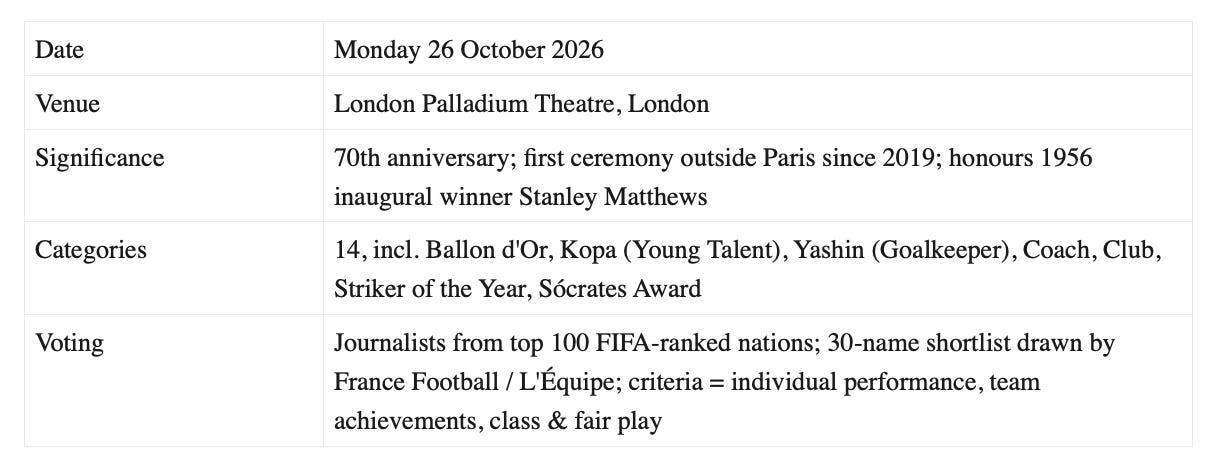
The 2026 Ballon d’Or ceremony takes place on Monday, the twenty-sixth of October, at the London Palladium Theatre in London. Not Paris. London.
That matters. This is the award’s seventieth anniversary, and organisers moved the ceremony out of Paris — for the first time since 2019 — specifically to pay tribute to the very first winner. In 1956, the inaugural Ballon d’Or went to Stanley Matthews of England. Seventy years later, the trophy comes to his country to celebrate.
There are fourteen categories this year, across the men’s and women’s games: the Ballon d’Or itself, Young Talent of the Year — the Kopa Trophy — Goalkeeper of the Year, the Yashin Trophy, Coach of the Year, Club of the Year, Striker of the Year, and the Sócrates Award for a player whose work off the pitch deserves recognition.
Thirty men on the shortlist. Thirty women. And one of the most genuinely open men’s races we’ve had since the Messi–Ronaldo era ended.
Segment two: how this thing is actually won
~3:00Before we argue, we need the rules. Because so much of Ballon d’Or shouting happens between people who don’t agree on what they’re voting for.
Here’s the mechanism. A panel of journalists from France Football and L’Équipe draws up the thirty-name shortlist. Then the ballots go out to media representatives from the top one hundred countries in FIFA’s men’s world ranking — that pool was narrowed in 2022, down from more than a hundred and eighty nations. Each voter ranks their selections, and the points are tallied.
And here’s the part people forget. Since 2022, voters have been explicitly asked to weigh three things:
- One — individual performances. Decisive actions. Overall impact on the pitch.
- Two — team performances and achievements.
- Three — class and fair play.
Read number two again. Team performances and achievements. That clause was written into the criteria on purpose, and it is the single biggest obstacle standing between my eventual pick and that trophy. Hold that thought. We’re coming back to it.
One more thing: the assessment window is closed. This award covers the 2025–26 club season and the 2026 World Cup. Nothing anybody does this September, this October, no hat-trick next weekend, changes a single vote. The evidence is already in. We’re just reading it.
Segment three: the season that decided it
~5:00So let’s read it. Because you cannot judge these thirty players without remembering what kind of year this actually was.
Paris Saint-Germain retained the Champions League. Thirtieth of May, the Puskás Aréna in Budapest, sixty-one thousand people. Arsenal went ahead inside six minutes through Kai Havertz. PSG equalised on the hour through an Ousmane Dembélé penalty. One-one after extra time, and then the shootout: PSG scored all four, Arsenal missed two — Eberechi Eze wide, Gabriel over the bar. Four-three. Vitinha was man of the match.
Back-to-back European Cups. Only Real Madrid had done that in the Champions League era, in 2016 and 2017. PSG also won a fifth straight Ligue 1 title, six points clear of Lens, under Luis Enrique.
Arsenal won the Premier League — their first in twenty-two years. And I want to sit with that for one second, because that is a genuine landmark, and Mikel Arteta is on the Coach of the Year shortlist for it. But Arsenal also lost a Champions League final on penalties and lost the League Cup final two-nil to Manchester City. Glory and heartbreak in the same twelve months.
Barcelona won La Liga back-to-back, eleven points clear of Real Madrid, and sealed it by beating Madrid in the final Clásico of the season. Bayern München took the Bundesliga, the German Cup and the Supercup — a treble of domestic silverware under Vincent Kompany. Inter won Serie A by thirteen points. Manchester City won the FA Cup, one-nil against Chelsea, and the League Cup.
And Real Madrid? Real Madrid had a year that belongs in a different kind of documentary. Xabi Alonso was sacked in January after a Clásico defeat, two hundred and thirty-three days into the job. Álvaro Arbeloa took the team. They finished second, went out of the Champions League to Bayern in a six-four aggregate quarter-final, and in June they appointed José Mourinho on a three-year deal. Mbappé’s employer, ladies and gentlemen.
Then came the summer.
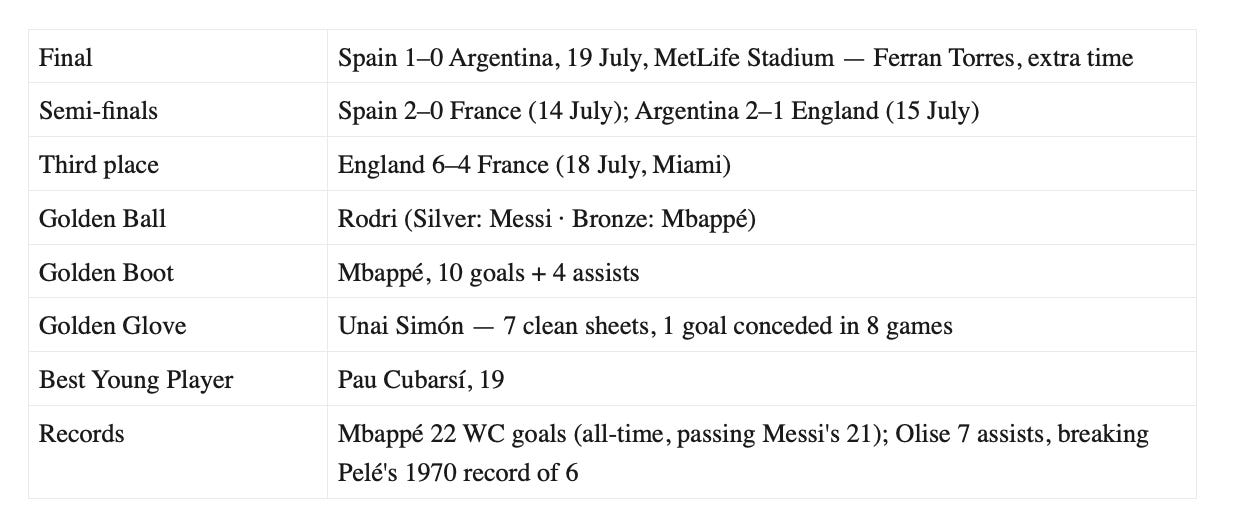
Spain won the World Cup. One-nil against Argentina at MetLife Stadium on the nineteenth of July, and the goal came in extra time, from Ferran Torres — a name on the Ballon d’Or shortlist, a man who has since moved from Barcelona to PSG for fifty million euros. Spain beat France two-nil in the semi-final. Argentina beat England two-one in the other.
The individual awards from that tournament tell you almost everything you need to know about this Ballon d’Or race:
- Golden Ball — best player of the tournament: Rodri.
- Silver Ball: Messi. Bronze Ball: Mbappé.
- Golden Boot: Mbappé, ten goals and four assists. Messi eight. Bellingham seven. Haaland seven. Kane six. Dembélé six.
- Golden Glove: Unai Simón of Athletic Club — seven clean sheets, and one goal conceded across eight matches.
- Best Young Player: Pau Cubarsí, nineteen years old.
And two records that deserve their own headline. Michael Olise of Bayern registered seven assists at that World Cup, breaking Pelé’s record from 1970 — a mark that had stood for fifty-six years. And Mbappé’s twenty-two, which we opened with.
There’s your season. Now let’s clear the room.
Segment four: the ones you should know about, quickly
~8:00A few names on these shortlists that have nothing to do with winning and everything to do with why we love this sport.
Vozinha. Goalkeeper, Cape Verde. He’s on the Yashin Trophy shortlist for Goalkeeper of the Year, alongside Thibaut Courtois and David Raya, having played his club football at Chaves and Colo-Colo. Cape Verde — population under six hundred thousand — at a World Cup, and Argentina needed a three-two win to get past them in the knockout round. Put that name in your mouth and say it with respect.
Bodø/Glimt. Nominated for Club of the Year, alongside Arsenal, Bayern, Flamengo and PSG. A Norwegian club from above the Arctic Circle, in the Champions League round of sixteen, where they won the first leg against Sporting three-nil before losing the return five-nil in extra time. Absolute cinema.
Julián Quiñones, Mexico, Al-Qadsiah. Sadio Mané, Senegal, Al-Nassr. Bruno Fernandes, Portugal, Manchester United. The shortlist reaches wider than it used to, and that’s a good thing.
For Coach of the Year, the men’s five are Mikel Arteta of Arsenal, Luis de la Fuente — who just won a World Cup with Spain — Unai Emery of Aston Villa, Vincent Kompany of Bayern and Luis Enrique of PSG. If you’re asking me: that’s a straight fight between the man who won the World Cup and the man who retained the European Cup, and I’d give it to de la Fuente by a fingernail.
And the Kopa Trophy for young talent is, frankly, a Spanish conversation: Lamine Yamal and Pau Cubarsí both on it, both World Cup winners, both teenagers, both at Barcelona. Cubarsí was named Best Young Player at the World Cup. Yamal is going to finish in the top two of the main award. Work that one out.
Segment five: the women’s race
~10:00Now, I promised the men’s race is the spine of this episode, but I am not going to skip past the women’s Ballon d’Or, because the story there is enormous.
Aitana Bonmatí is not on the shortlist. The reigning winner, the most decorated individual player in the women’s game over the last three years, missed the cut entirely after an injury-hit season. That alone blows the race wide open.
And into the gap steps Alexia Putellas — who, for this qualifying season, was a Barcelona player, and who is now a London City Lionesses player after signing a three-year deal in the Women’s Super League in July. Twenty-four goals, thirteen assists, and a Barcelona side that won a quadruple, including the Champions League with a four-nil demolition of OL Lyonnes in the final. A third Ballon d’Or for Putellas would be one of the great late-career statements.
But look at the other numbers, because they’re absurd. Ewa Pajor, Barcelona and Poland: thirty-three goals, and she scored in all five Champions League knockout ties, including twice in that final. Khadija “Bunny” Shaw, Manchester City and Jamaica: thirty-nine goals, twenty-one of them in a title-winning WSL campaign, plus the FA Cup. Pernille Harder at Bayern: thirty-four goals and a domestic treble. Melchie Dumornay of Haiti and OL Lyonnes, who is simply one of the most exciting footballers alive.
Barcelona have eight players on that shortlist. If you want my one-line call: Putellas, with Pajor breathing down her neck, and Shaw as the outsider the scoring charts say deserves more respect than she’ll get.
Right. Enough throat-clearing.
Segment six: clearing the shortlist
~12:00Thirty men. Most of them are not winning this, and it’s worth saying why, because the why is where the interesting arguments hide.
There are ten PSG players on that list — Dembélé, Hakimi, Kvaratskhelia, Marquinhos, Nuno Mendes, João Neves, Pacho, Fabián Ruiz, Upamecano and Vitinha — and an eleventh, Ferran Torres, who has joined them since. They retained Europe. They split their own vote to pieces.
Khvicha Kvaratskhelia deserves better than he’ll get: nineteen goals for PSG and the first player in Champions League history to score or assist in seven consecutive knockout matches. But Georgia weren’t at the World Cup, and in a World Cup year that’s a ceiling you cannot climb.
Ousmane Dembélé, the defending Ballon d’Or holder, was PSG’s top scorer with twenty goals, scored the penalty in the Champions League final and got six at the World Cup including a hat-trick against Norway. In most years, that’s a top-three finish. This year his own teammates and a World Cup winner get in the way.
Erling Haaland — fifty-eight goals across the campaign, the FA Cup, the League Cup, and then seven goals at a World Cup where he dragged Norway to their first quarter-final ever, their first tournament since 1998, with a brace that knocked Brazil out. Brilliant. But no league title, no European trophy, and a quarter-final exit.
Michael Olise — twenty-six goals, forty-one assists, Bayern’s treble, and Pelé’s fifty-six-year-old World Cup assist record in his pocket. Genuinely one of the best players in the world now, and I suspect he finishes higher than anyone expects.
Lionel Messi, thirty-nine years old, MLS Cup winner and MLS Cup Final MVP with Inter Miami, then eight goals and four assists at a World Cup where he took Argentina to a third consecutive final and lost it without scoring. The Silver Ball. If sentiment decided this award, he’d be holding it. Sentiment doesn’t.
Vinícius Júnior signed a new six-year deal at Real Madrid and put up twenty-eight goals and sixteen assists, but in a trophyless Madrid season that’s a fourteenth-place-in-the-rankings kind of year.
And spare a thought for Marc Cucurella, who was a Chelsea player last season and is a Real Madrid player now; Rodri, a Manchester City player last season and a Barcelona player now after a seventy-five-million-euro move in August; and Emiliano Martínez, who left Aston Villa for Chelsea. Read the shortlist carefully, because half of it moved house this summer.
Now. The top three.
Segment seven: number three — Rodri
~14:00At number three: Rodri.
Here is the case, and it’s a strange one. His club season was compromised — fitness problems, two goals, a Manchester City campaign that brought the FA Cup and the League Cup but no league title and no European run. On the raw club evidence, he shouldn’t be near this conversation.
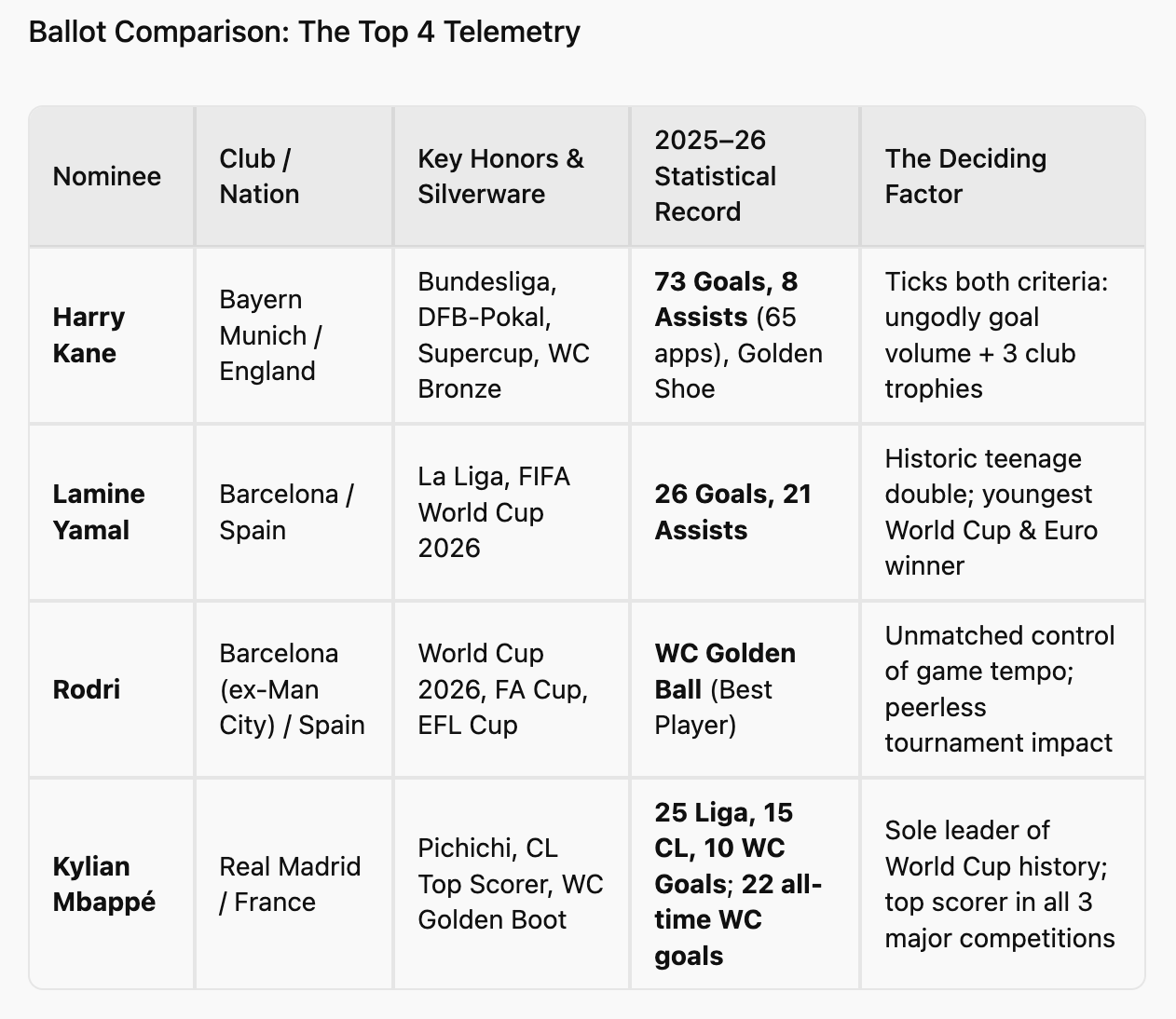
Then he went to a World Cup and was named the best player at it. The Golden Ball. Spain won the tournament without conceding much of anything — Unai Simón gave up a single goal in eight matches — and the reason for that is a midfielder who decides the tempo of a football match the way a conductor decides the tempo of an orchestra. You don’t measure Rodri in goals. You measure him in the games your team doesn’t lose.
He is now a Barcelona player. And there is a real precedent here: the voters gave Rodri this award in 2024 on a similar argument. Do it twice? That’s the question.
He’s third on my list because the Golden Ball is the single most powerful credential in the room — but a two-goal club season is a hard thing to build a Ballon d’Or on.
Segment eight: number two — Lamine Yamal
~15:30At number two: Lamine Yamal. Barcelona. Nineteen years old.
Twenty-six goals, twenty-one assists. A La Liga title. And then the World Cup, which made him the youngest player in history to win both a World Cup and a European Championship — and he did it days after his nineteenth birthday. Nineteen. At an age when most players are learning how to hold the ball, he has a Euro and a World Cup and finished second in last year’s Ballon d’Or.
That is a career that’s already complete, and it’s barely started.
So why isn’t he first? Two reasons, and I’d rather say them out loud than pretend.
The first is injuries — he missed chunks of the club season. The second is more uncomfortable: his World Cup, while good, was not the tournament people expected from him. Spain won and he contributed, but he was not the decisive figure of that final. The Golden Ball went to Rodri. The Best Young Player went to Cubarsí. In a tournament Spain won, Yamal was arguably the third-best Spaniard in the room.
He will win this award. Probably more than once. I don’t think this is the year — but if the voters decide that “World Cup winner plus La Liga winner plus nineteen years old” is the whole story, he lifts it and nobody can say it was theft.
Segment nine: number one — Harry Kane
~17:00And the favourite, the man I think actually wins it on the twenty-sixth of October: Harry Kane.
Sit down for these numbers.
Between August 2025 and July 2026, for Bayern München and England, Harry Kane scored seventy-three goals and added eight assists in sixty-five appearances.
Seventy-three.
Thirty-six in the Bundesliga, with five assists in thirty-one league games — a third consecutive Torjägerkanone as Germany’s top scorer. Fourteen in the Champions League. Ten in the German Cup. Twelve for England, six of them at the World Cup. His second European Golden Shoe, and he finished nine goals clear of Haaland. He’s on ninety-eight Bundesliga goals from ninety-four games, which is a rate that shouldn’t be legal.
Context for the seventy-three: that is the second-best scoring season by any player since the year 2000. The only one better is Messi’s eighty-two in 2011–12. That’s the company.
And crucially — that clause in the voting criteria, team performances and achievements — Kane delivers. Bayern won the Bundesliga, the German Cup and the Supercup. England finished third at a World Cup, their best result since 1966, and Kane scored six along the way.
The man who spent a decade being mocked as a trophyless goalscorer arrived at this ceremony with three club trophies, a World Cup bronze medal, a Golden Shoe, a Torjägerkanone and seventy-three goals.
If the Ballon d’Or is what it says it is — individual brilliance, team success, and decisive impact — Harry Kane is the answer. That’s my number one. That’s who I expect to hear called.
Segment ten: but here’s who should win it
~19:00And now I’m going to disagree with myself.
Because “who will win” and “who should win” are two different questions, and I host this podcast, so I get to answer the second one.
Kylian Mbappé.
Real Madrid. Twenty-seven years old. And a year that, in almost any other season in football history, would have ended this argument before it started.
Look at what he actually did. Twenty-five league goals in thirty-one matches to win the Pichichi — his second in a row, which puts him in a group at Real Madrid containing Di Stéfano, Puskás, Amancio, Hugo Sánchez and Cristiano Ronaldo. Fifteen goals to finish top scorer in the Champions League, ahead of Kane’s fourteen. Ten goals to win the World Cup Golden Boot.
Top scorer in La Liga. Top scorer in the Champions League. Top scorer at the World Cup. In one season. Name me the last man who did all three.
And he did it in a year where his club sacked its manager in January, finished eleven points behind Barcelona, went out of Europe in a six-four aggregate quarter-final against Bayern, and then hired Mourinho in June. He put forty goals into La Liga and the Champions League alone, for a team in open chaos, and then went to North America and rewrote the record book.
Twenty-two World Cup goals in twenty-two World Cup matches.
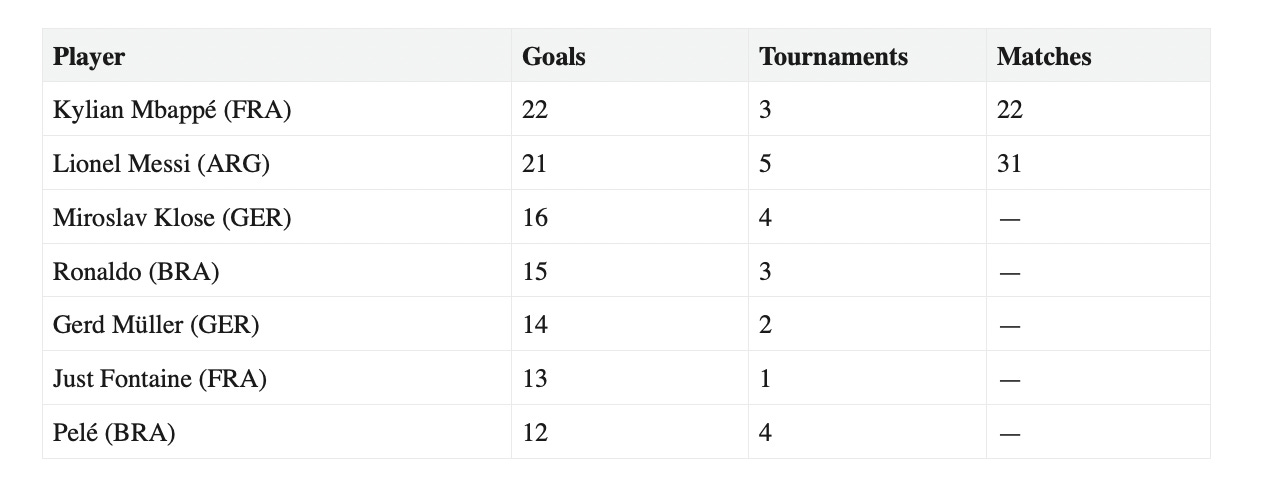
Let me put that beside the rest of the list. Messi: twenty-one goals in thirty-one matches across five tournaments. Klose: sixteen. Ronaldo of Brazil: fifteen. Gerd Müller: fourteen. Just Fontaine: thirteen. Pelé: twelve.
Mbappé has almost twice Pelé’s World Cup tally, and six more than Miroslav Klose managed across four tournaments. He got there in three. He got there at an age where he can reasonably expect two more.
That is the record I care about, and here’s why. Club records are comparable — leagues play thirty-eight games a year, every year, and the numbers pile up. World Cup goals are different. You get seven or eight matches, once every four years, against the best defenders on earth, with a nation’s expectations sitting on your chest, and you have to do it across at least three tournaments to even enter the conversation. It is the single hardest scoring record in football to accumulate, because you cannot grind it out. You have to be brilliant on a handful of specific nights, spaced a presidential term apart.
Now, I’ll be honest with you about the counter-argument, because this is a football podcast, not a fan page.
Counter-argument one: the criteria say team achievements count, and Mbappé won nothing. Nothing. No league, no cup, no Europe, no World Cup. Fourth place and a Pichichi. That’s a real hole and I’m not going to paper over it.
Counter-argument two — and this one is sharper — is whether the record is as durable as I’m claiming. The World Cup is forty-eight teams now. The road to a final is eight matches, not seven. More games means more chances, which means the next great forward has a slightly easier climb than Mbappé had. And Mbappé himself can extend it in 2030 at thirty-one and 2034 at thirty-five. So the record might not be untouchable — but it will be the reference point for every forward who walks onto a World Cup pitch for the next twenty years, and the man who set it did it in a perfect twenty-two-from-twenty-two.
So here’s my ballot. Kane will win it, and he’ll deserve it. Yamal and Rodri will be close, and they’ll deserve that too.
But if you gave me the vote, I’d write down Kylian Mbappé. Because the Ballon d’Or is supposed to honour the best footballer of the year, not the luckiest one, and in 2026 the best footballer in the world played for a broken club and finished fourth at a World Cup while outscoring every human being in Spain, in Europe, and on the planet’s biggest stage — and then walked away holding a record that no player in seventy years of this award had ever held.
Trophies are collective. Twenty-two in twenty-two is his alone.
Outro
That’s the case. Twenty-sixth of October, the London Palladium, seventy years after Stanley Matthews. We’ll find out together.
Now tell me I’m wrong. Kane, Yamal, Rodri, Olise, Messi, Dembélé, Haaland — make your case, because I want to hear it.
I’m Etienne Noumen. This has been The Black Mambas of Football and Soccer Podcast. Subscribe, leave a rating, and send me your top three.
Appendix: fact sheet
2025–26 club season
- Champions League: PSG 1–1 Arsenal (4–3 pens), 30 May, Puskás Aréna, Budapest. Havertz 6′; Dembélé 61′ pen. Eze & Gabriel missed. MOTM Vitinha. Att. 61,035. PSG back-to-back — second club in the CL era after Real Madrid (2016, 2017). CL top scorers: Mbappé 15, Kane 14, Gordon 10.
- Premier League: Arsenal (first in 22 years). La Liga: Barcelona, back-to-back, 11 pts clear of Real Madrid. Bundesliga: Bayern. Serie A: Inter, 13 pts clear of Napoli. Ligue 1: PSG, 5th successive, 6 pts clear of Lens. Primeira Liga: Porto.
- FA Cup: Man City 1–0 Chelsea (16 May). EFL Cup: Man City 2–0 Arsenal (22 Mar), Nico O’Reilly ×2.
- CL quarter-finals: Bayern 6–4 Real Madrid; Atlético 3–2 Barcelona; PSG 4–0 Liverpool; Arsenal 1–0 Sporting CP. Bodø/Glimt out in R16 (won 1st leg 3–0 v Sporting, lost 2nd 5–0 a.e.t.).
- Women’s CL: Barcelona 4–0 OL Lyonnes; Barcelona won a quadruple.
- Real Madrid: Xabi Alonso sacked Jan 2026 (233 days) after a Clásico defeat → Arbeloa; Mourinho appointed 11 June 2026 on a 3-year deal.
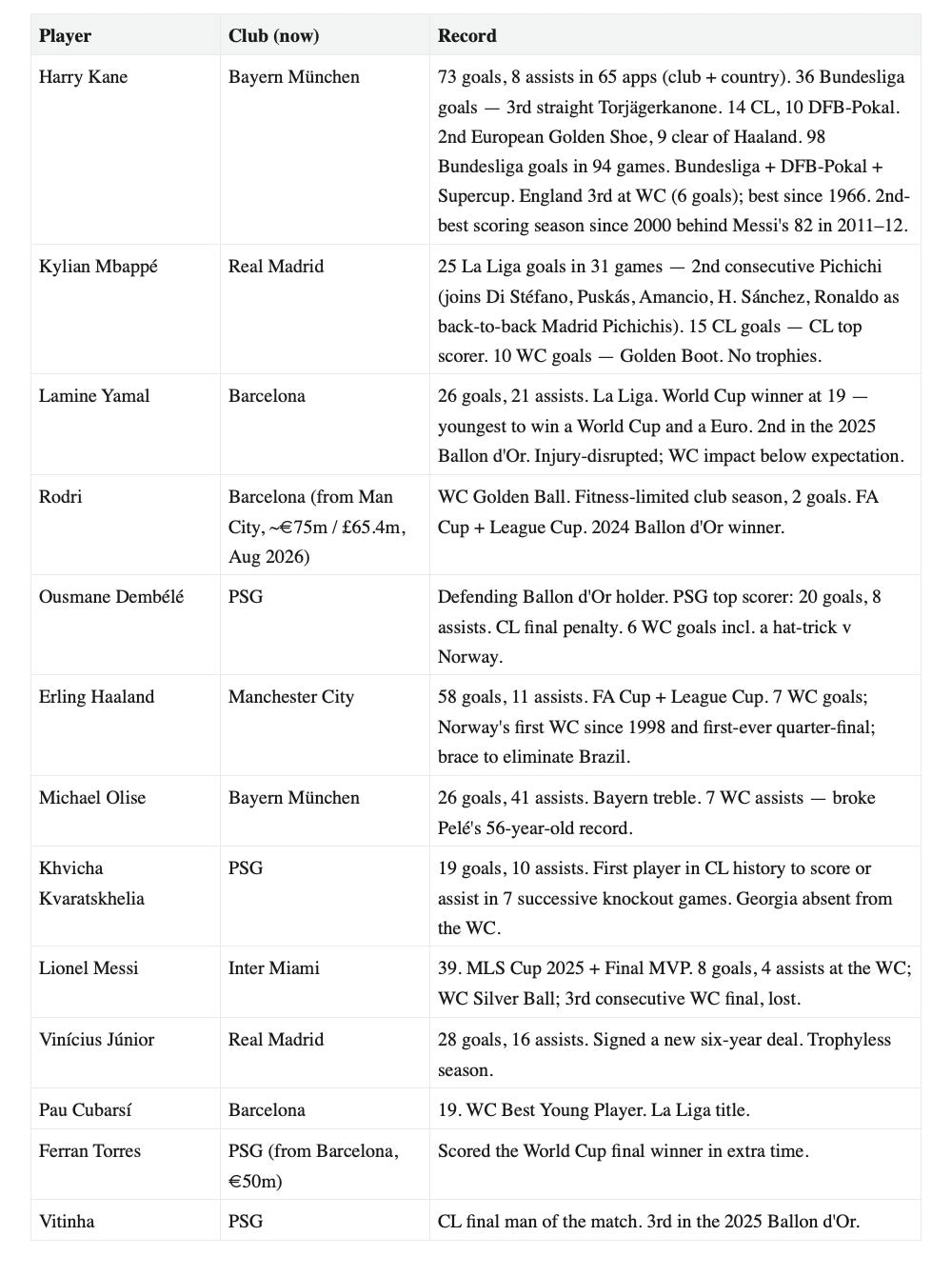
Key player seasons (Aug 2025 – Jul 2026)
Transfers to watch on the shortlist
- Rodri: Man City → Barcelona
- Marc Cucurella: Chelsea → Real Madrid
- Ferran Torres: Barcelona → PSG
- Emiliano Martínez: Aston Villa → Chelsea
- Dayot Upamecano: Bayern → PSG
- Alexia Putellas & Mapi León: Barcelona → London City Lionesses
Women’s race
- Aitana Bonmatí is not shortlisted — injury-hit season. Reigning winner.
- Alexia Putellas (Barcelona → London City Lionesses): 24 goals, 13 assists; Barcelona quadruple. Frontrunner.
- Ewa Pajor (Barcelona, Poland): 33 goals; scored in all five CL knockout ties incl. twice in the final.
- Khadija “Bunny” Shaw (Man City, Jamaica): 39 goals, 21 in a WSL-winning season + FA Cup.
- Pernille Harder (Bayern, Denmark): 34 goals, 14 assists; domestic treble.
- Melchie Dumornay (OL Lyonnes, Haiti): 22 goals, 12 assists.
- Barcelona have 8 nominees.
Shortlists
- Men’s Coach: Arteta (Arsenal), de la Fuente (Spain), Emery (Aston Villa), Kompany (Bayern), Luis Enrique (PSG).
- Men’s Club: Arsenal, Bayern München, Bodø/Glimt, Flamengo, PSG.
- Men’s Goalkeeper (Yashin): Bounou, Courtois, Joan García, Kobel, E. Martínez, Mendy, Raya, Safonov, Unai Simón, Vozinha.
- Men’s Kopa: Alajbegović, Bouaddi, Cubarsí, Diomandé, Karl, Kroupi, Yamal, Manzambi, Maza, Zaïre-Emery.
Sources
- 2026 Ballon d’Or awards nominees revealed — UEFA
- Nominees announced for 2026 Ballon d’Or awards — UEFA
- Ballon d’Or 2026: Full List of Nominees — Sports Illustrated
- How Ballon d’Or voting works — Yahoo Sports
- Ballon d’Or 2026 Power Rankings — Goal.com
- Ballon d’Or Féminin 2026 Power Rankings — Goal.com
- 2026 Ballon d’Or shortlist: Bonmatí misses cut — Just Women’s Sports
- 2026 World Cup award winners — NBC Sports
- FIFA World Cup 2026 Awards — Bleacher Report
- Mbappé breaks all-time World Cup scoring record — Al Jazeera
- All-Time World Cup Top Scorers — FOX Sports
- Spain wins 2026 World Cup — CBS News
- Spain is the 2026 World Cup champion — NPR
- Olise breaks Pelé’s World Cup assist record — Bundesliga.com
- Haaland leads Norway on a historic run — Yahoo Sports
- Breaking down Harry Kane’s 2025/26 numbers — Bundesliga.com
- Mbappé wins the Pichichi Trophy 2025/26 — Real Madrid
- Mbappé’s 2025–26 season — Sofascore
- 2026 UEFA Champions League final — Wikipedia
- Arsenal end 22-year wait for Premier League title — Premier League
- Man City beat Chelsea 1–0 to win the 2026 FA Cup — The FA
- 2026 EFL Cup final — Wikipedia
- Rodri seals transfer to Barcelona — ESPN
- Real Madrid complete signing of Marc Cucurella — ESPN
- Biggest deals of the 2026 summer transfer window — Goal.com
- Vinícius Jr. agrees new six-year deal — ESPN
- Putellas joins London City Lionesses — ESPN
- José Mourinho named Real Madrid coach — Al Jazeera
- Alonso sacked by Real Madrid, replaced by Arbeloa — Al Jazeera
- Kvaratskhelia first to score or assist in 7 consecutive knockout games — Tribuna
- Where the 2026 Women’s Champions League final was won — UEFA
- Ballon d’Or 2025 official rankings — Goal.com
- Rodri wins the 2024 Men’s Ballon d’Or — UEFA
This episode first appeared on the Show Up And Play Substack.
Tell me I’m wrong
New episodes of The Black Mambas of Football and Soccer Podcast, plus honest guides to clubs, fees and tournaments across Canada. Free, no sign-up.